By Dr. Alexander Roth, MD · November 12, 2026
If you are researching a hair transplant, FUE vs FUT is probably one of the first comparisons you found. Both methods move hair from the donor zone at the back and sides of the scalp to thinning areas. The main difference is how the grafts are removed, and that affects your scar, your hairstyle options and your early recovery. Neither method is right for every patient. Here is how they compare, including the trade-offs that are easy to miss.
The basic difference
FUT (follicular unit transplantation), also called strip surgery, removes a narrow strip of scalp from the donor zone. The surgeon closes the incision, and the team dissects the strip under magnification into individual follicular unit grafts.
FUE (follicular unit excision) removes follicular units one at a time with a small punch, so there is no strip and no sutured incision. A manual FUE procedure uses a handheld instrument, while robotic FUE uses an image-guided system to assist with harvesting.
The International Society of Hair Restoration Surgery describes FUE and FUT as tools for harvesting donor hair rather than as one correct answer. Once the grafts are harvested, either way, they still have to be placed with care. Hairline design and graft placement matter under both methods.
Scars: neither method is scar-free
FUT leaves one linear scar across the donor zone. Hair above it usually covers it when worn long enough, but it can show with a very short cut. Scars can also widen, and strenuous activity too soon after surgery is one reason.
FUE avoids a linear scar but leaves many small round scars spread across the donor zone. One published review noted pale scars of about 1.5 to 1.6 mm that are often visible, and its authors called “scarless” a misnomer. These scars are generally easier to conceal at short lengths, but they are not invisible, particularly with very close clipping or after heavy harvesting.
A practical question to ask yourself is how short you want the option to wear your hair, both now and years from now.
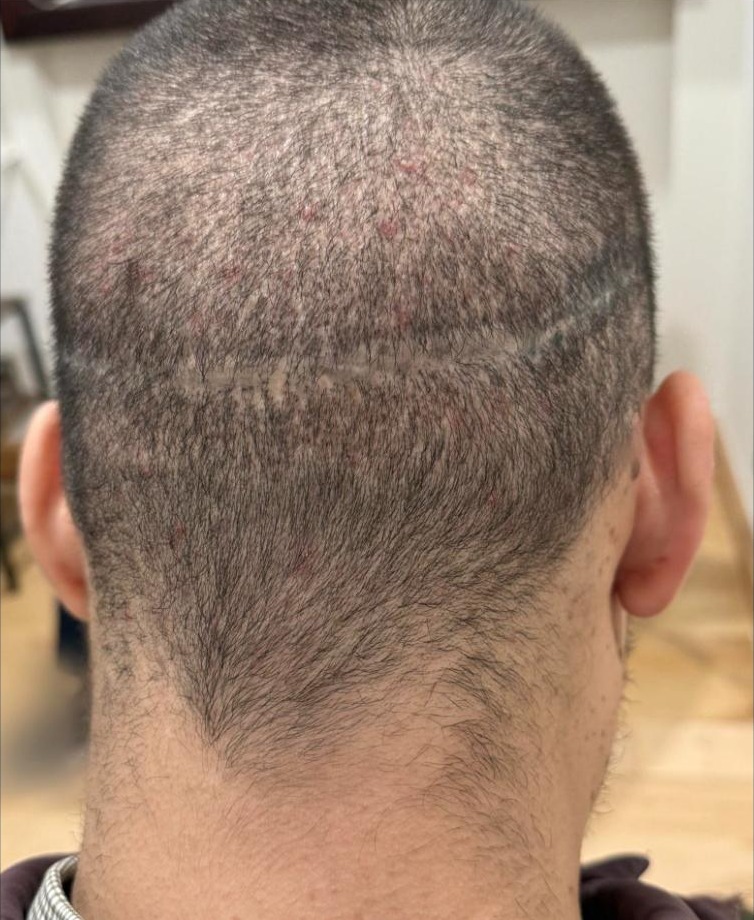
Shaving and how the donor area looks at first
Larger FUE sessions usually involve clipping the donor area. The small harvest sites then become less noticeable as the surrounding hair grows back, often over a couple of weeks. A manual no-shave FUE procedure, which we offer to men and women, can instead use a small shaved window hidden under longer hair. It does not suit every case, and the number of grafts needed is part of that decision.
With FUT, the surrounding hair is generally left at its existing length and can cover the closed incision while it heals. That can be useful for patients who do not want their hair clipped, as long as they accept the trade-off of a linear scar.
Recovery and comfort
Both procedures are typically done with local anesthesia. According to the International Society of Hair Restoration Surgery, FUE offers a faster recovery than FUT, and many patients report less pain after FUE. In one study of 241 patients, the FUE group reported significantly less postoperative pain than the FUT group. Individual experiences vary.
The biggest practical difference involves the donor area. FUT requires care for a closed incision until the stitches or staples are removed, and it can come with longer limits on strenuous activity. FUE leaves small open sites that heal on their own, although you will still have activity limits at first. The recipient area needs careful handling after either method, and shedding of transplanted hairs usually occurs between weeks 2 and 6. Follow your own written instructions rather than a general timeline.
Graft quality, session size and donor supply
Transection, or damage to a follicle during harvesting, is a known concern with FUE because the surgeon works without seeing the whole follicle below the skin. Grafts can also have less protective tissue around them, so skill and careful handling matter. Published data on graft survival have been inconsistent, with some reports favoring FUT and others finding similar results. Technique and team experience can matter as much as the method itself.
The two methods also use the donor zone differently. FUT takes grafts from a concentrated strip, while FUE spreads extraction across a wider area. That can reach hair outside the most stable part of the donor zone if harvesting extends too far. Over-harvesting can leave the donor area looking thin or uneven, and FUE scars add up across sessions.
Donor hair is limited with either method, so large cases need long-term planning. Our guide to how many grafts you may need explains how the Norwood scale and donor supply fit into that estimate.
Who may lean toward each method
These are common considerations rather than rules:
- FUE may suit you if you want to wear your hair short, have a tight scalp, have a history of wide scars, want to return to strenuous activity sooner, or have an existing strip scar and not enough scalp laxity for another strip.
- FUT may suit you if you keep your hair long enough to cover a linear scar, need a large number of grafts in one session, or do not want your donor area clipped.
- Cost may also differ. FUT is usually less expensive because it takes less surgeon labor, but prices vary by practice and case.
Questions to ask before you choose
We perform manual and robotic FUE at New York Hair Transplant, so you should read this comparison knowing that. Ask any surgeon, including us, to explain why a method fits your case and what the alternatives are. These questions are a good place to start:
- How many grafts do you estimate I need now, and what could I need later?
- What will my donor area look like at the hair length I prefer?
- What scar should I expect, and how visible could it become?
- Who performs each step of the procedure?
- What activity limits will I have, and for how long?
At our office at 132 E 72nd St on the Upper East Side, we examine your scalp, donor density and pattern of loss before discussing options. This article is general education and not personal medical advice, and results vary.
Frequently asked questions
Is FUE better than FUT?
Not universally. FUE avoids a linear scar and often means an easier early recovery. FUT can be useful for some patients who keep their hair longer. The right choice depends on your donor area, your goals and your preferred hairstyle.
Does FUE leave scars?
Yes. FUE leaves many small round scars instead of one linear scar. They are often easy to conceal, but they can become visible with a very short cut or after extensive harvesting.
Which heals faster, FUE or FUT?
FUE generally has a faster donor-area recovery because there is no sutured incision. Your timeline depends on the size of your procedure, how you heal and your surgeon’s instructions.
Can I have FUE after a previous FUT procedure?
Often, yes. FUE can be an option when a patient has limited scalp laxity for another strip or has a wide existing scar. A donor area exam is needed to determine how much usable hair remains. For example, one of our patients came to us after FUT and several FUE procedures at other practices, and our FUE procedure was his fifth hair transplant. Repeat procedures use up donor supply, so every additional session needs a long-term plan.
Talk through your options
A good plan starts with an exam, not a preference for one technique. Book a free consultation or call (212) 249-6969 to meet our team at New York Hair Transplant and discuss whether FUE is right for you.